Welcome to the little mill. A website devoted to mills in the UK.
Mills are fascinating. They have played a very central role in rural UK and many mills have been the hearth of the surrounding farmland. The economic importance of mills can not be understated. They allowed the area to refine their wheat in to flour, their wood into lumber and much, much more. The construction of a mill could help improve the standard of living in an area dramatically and to live in an area without a mill made life a lot harder than life was in an area with a mill.
More than just flour
A lot of people think about wheat and flour when they hear the word mill. This is easy to understand since one of the meanings of the word mill is to grind and it is true that mills that converted wheat and other types of corn into flour have played an important historical role. But this was far from the only type of mill. Far from the only thing a mill could do.
Mills were factories and they could do a lot of things. Mills where used to produce paper, lumber, metal objects and a lot of other things. Mills are simply automated production facilities that use the energy from water, wind, tidal movements or other sources to help make productions more effective.
Lets look at water mills. They used the awesome force of creeks and rivers to power their production. This energy could be used to mill, but it could also be used to hammer to make it easier to smith metal objects or to power a saw blade to cut wood into lumber.
Mills allowed for automated production before we learned how to use oil, gas and electricity to power or factories. Mills are a very easy and elegant solution to harness the power of water and wind to improve the life of people.
Ancient history
Humans have used mills to help them with heavy tasks for a very long time. There are plenty of example of ancient mills and we know that mills were used in the centuries before the birth of Christ. The first know water mills in continental Europe is believed to have been built in the first century AD. The technology was brought their by the Romans. Little is known about when the first mills where built in the UK. There is no firm evidence of early mills but roman aqueducts suggest that there are ancient mills still waiting to be discovered any many historians believe that the first UK mills where constructed in the 1st century AD. The oldest remaining UK mills where built a lot later then this.
⚙
The Evolution of Mills in the United Kingdom
From Anglo-Saxon watermills and post windmills to the Industrial Revolution’s steam-powered textile factories
Domesday Census
5,624 Watermills
Recorded across England in 1086
First Modern Factory
Cromford Mill
Richard Arkwright (1771)
Structural Milestone
Iron-Framed Flax Mill
Ditherington (1797) / “Grandparent of Skyscraper”
Global Manufacturing Peak
“Cottonopolis”
Manchester & Pennine river valleys
Era / Date
Mill Development
Power Source / Type
Historical Context & Technological Impact
Roman & Saxon c. 100 – 900 AD
Early Vertical & Horizontal WatermillsGrain Milling
Stream Waterwheels (Undershot & Norse Mills)
Romans introduced vertical waterwheels with right-angle gearing along rivers like Hadrian’s Wall (Chesters Bridge). By the 8th century, Saxon estates widely deployed vertical undershot wheels and horizontal “click” mills for community corn and grain grist milling.
1086
The Domesday Survey RecordsManorial Monopoly
River Watermills (5,624 sites)
William the Conqueror’s census confirmed watermills as ubiquitous across England, recording an average of one mill for every 50 households. Manorial law established “mill soke”, compelling tenants to grind grain exclusively at the lord’s mill for a multure fee.
Late 12th Century c. 1185
Arrival of the Post WindmillWind Power
Post Windmills (Wood Body on Main Trestle)
Earliest documented English windmills appeared in Yorkshire and East Anglia (e.g., Weedley, 1185). The entire wooden body rotated on a massive central post to catch shifting winds, freeing communities from river basin dependency.
Water power was adapted beyond food to industrial processing. Cam mechanisms allowed rotary waterwheels to operate heavy trip-hammers for wool fulling (cleansing and thickening cloth), iron bloomeries, paper production, and sawmills across the West Country and Yorkshire.
1721
Lombe’s Silk Mill in DerbyFactory System Birth
River Derwent Waterwheel
John and Thomas Lombe erected a 5-storey mill housing Italian-style silk-throwing machines driven by a single 7-metre waterwheel. Recognized as the world’s first fully mechanized manufacturing factory under a single roof.
1771
Arkwright’s Cromford Mill (Derbyshire)Mass Textile Production
Water Frame (Bonsall Brook water)
Richard Arkwright harnessed water power to drive his spinning water frame, inventing the modern factory system. Cromford integrated standardized shift labor, specialized mill housing, and vertical production flows replicated globally.
1786
Albion Mills & Rotary SteamSteam Transition
Boulton & Watt Rotary Steam Engines
London’s Albion Flour Mills, engineered by Matthew Boulton and James Watt, used double-acting rotative steam engines to grind grain. Steam freed mills from geographic river valley constraints, shifting expansion to coalfield urban centers.
Architect Charles Bage designed the world’s first iron-framed building to eliminate catastrophic timber mill fires. Its cast-iron columns and beams earned Ditherington the title “the grandfather of the modern skyscraper.”
19th Century 1830 – 1900
The Age of “Cottonopolis” & Wool TitansHigh Industrial Age
Multi-Cylinder Steam Engines (Beam, Corliss)
Lancashire and West Yorkshire became the textile capital of the world. Monster complexes like Titus Salt’s Saltaire Mill (1853) and Stockport’s red-brick cotton mills ran hundreds of thousands of spindles and automated looms, giving rise to the Factory Acts regulating child labor and working hours.
20th c. – Present
Decline, Electric Power & Heritage RepurposingIndustrial Heritage
Grid Electricity & Heritage Sites
Competition from global producers led to widespread closures of UK textile mills between 1950 and 1980. Today, key sites—including the Derwent Valley Mills, Saltaire, and New Lanark—are protected UNESCO World Heritage Sites, repurposed as residential apartments, cultural museums, and creative tech campuses.
Industrial Heritage: The mill represents the architectural nucleus of British industrialization. Over nine centuries, the concept transformed from solitary wooden stream wheels grinding manor grain into vast multi-storey brick and cast-iron complexes powered by steam, establishing modern shifts, labor legislation, and urban factory towns worldwide.
Visiting mills
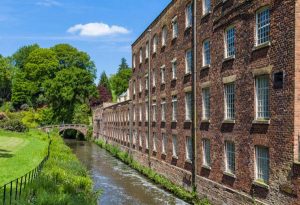
Quarry Bank Mill
Visiting mills around the UK can give you a good insight into how life and industry looked at the time the mill was active. Many mills are remarkable well preserved and is well worth a visit. It is easy to think that an older mill is more interesting to visit but this is not always the case. The fact is that the opposite can often be true. By visiting a more modern mill it is easier to connect to and understand the technology used in the mill. The mills also tends to be in more original condition. Masson mill is a good example of a more modern mill that is well worth a visit. Older mills can be so far removed from our modern technology that it is hard to understand and connect to how life might have been in the mill when it was still operating. Personally I visit every mill I get the chance to visit. I understand that this might not be every ones idea of a fun time but i still recommend that you try visiting a few mills. I recommend that you start with watermills since they usually are located in very beautiful areas that are easy to enjoy even if you do not like the mill itself. Stretton watermill and Quarry bank mill are two good examples of this.