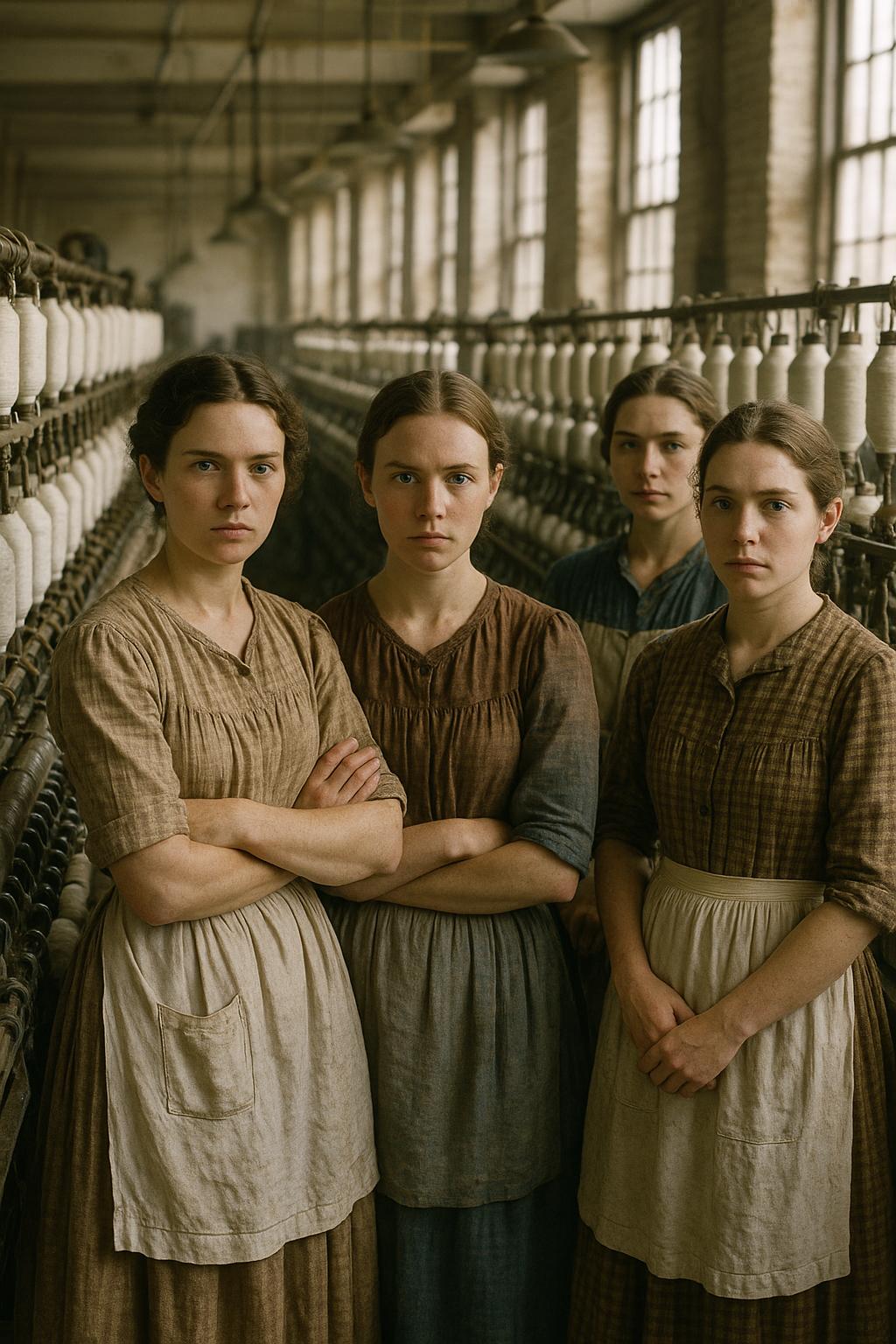
The Lowell Mill Girls: An Industrial Revolution Icon
Background and Origins
In the early 19th century, the United States embarked on a transformative journey as the Industrial Revolution began reshaping its landscape. Central to this upheaval was the rise of the American textile industry, which flourished due to the advent of water-powered mills. Inspired by established models from England, these textile mills became emblematic of the new world of mass production. Among the first cities to emerge as an industrial powerhouse was Lowell, Massachusetts. By the 1830s, it boasted some of the nation’s largest textile mills.
Central to Lowell’s vibrant industrial scene were the mill girls, a group composed mostly of young women. They left their rural homes across New England, drawn by the promise of employment and financial stability that factory jobs offered. These women represented a significant shift in the American labor force, as they stepped into roles traditionally held by men or were entirely new opportunities for women.
The Workforce and Living Conditions
Typically aged between 15 and 30, the Lowell mill girls were a diverse group, unified by their pursuit of better prospects. Although the mills provided wages that were substantial relative to other female-dominated occupations of the era, the work itself was rigorous. Each day, these women endured grueling shifts that lasted from 12 to 14 hours, in conditions that were often far from comfortable. Despite such challenges, the allure of a steady income provided them a level of financial autonomy that was quite unprecedented for women in that era.
To accommodate this burgeoning workforce, mill owners established company-owned boarding houses. These residences offered basic amenities and became communal living spaces governed by a strict code of conduct. The rules, intended to maintain the women’s moral standards and productivity, often regulated their personal lives closely. Yet, despite—or perhaps because of—these regulations, a strong sense of community emerged within these houses. Bonds formed beyond shared occupancy, as friendships extended into the workplace, creating a support network that would prove crucial as the women pursued their personal and collective aspirations.
Education and Cultural Impact
Beyond their roles as laborers, the mill girls exhibited an insatiable appetite for education and personal development. Unlike many of their contemporaries, they had access to various educational resources offered by the corporation, demonstrating a forward-thinking approach to employee welfare that was ahead of its time. Educational lectures, an expansive library, and evening classes were frequently patronized by the mill girls, serving as a catalyst for their intellectual growth.
This environment nurtured not only a community of informed workers but also a group of socially aware individuals. Their engagement with knowledge and the arts became a hallmark of the Lowell mill girls’ culture. This growing sense of awareness and expression culminated in the publication of *The Lowell Offering*, a magazine created and operated by the mill girls that showcased their literary talents. The publication enjoyed a readership that extended well beyond the local community, marking an important chapter in the intersection of labor, education, and literature.
Labor Movement and Legacy
The challenges faced by the mill girls transcended the confines of the factory floors. As the mills aimed to increase profits, wage cuts became a frequent occurrence, propelling the workers into the realm of activism. The girls’ response was both courageous and groundbreaking; they organized strikes and protests throughout the 1830s and 1840s, demanding fair compensation and better working conditions. Although these early efforts did not always result in immediate victories, they planted crucial seeds for the American labor movement.
The mill girls’ activism did not only emphasize workers’ rights, it also challenged societal perceptions of women’s roles both inside and outside the workforce. Their efforts emphasized the need for a more equal playing field—a principle that would resonate throughout subsequent generations. While the physical mills of Lowell may have evolved or been repurposed over time, the legacy of the mill girls endures. Their story continues to resonate as an inspiring narrative of resilience and empowerment, impacting industrial, social, and labor history on multiple levels.
Today, the legacy of the Lowell Mill Girls continues to serve as a testament to their significant contributions. Those interested in delving deeper into this pivotal period in American history can visit the Lowell National Historical Park, which offers a vivid representation of the era. It stands as a reminder of the enduring impact these young women had on the path to progress. To learn more, consider exploring their [site](https://www.nps.gov/lowe/index.htm), where visitors can gain a comprehensive understanding of the Lowell mill girls and their role in the broader tapestry of the American Industrial Revolution.